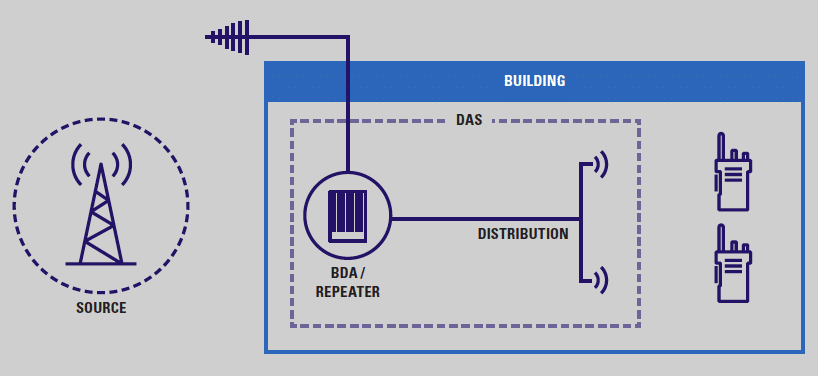
A Distributed Antenna System (DAS) distributes radio frequency (RF) signals throughout a building using strategically placed antennas.
A Bi-Directional Amplifier (BDA) strengthens weak radio signals from outside the building and rebroadcasts them inside—while also amplifying signals from inside the building back out to the radio network.
Together, a BDA/DAS system ensures:
Clear two-way radio coverage in stairwells, basements, and mechanical rooms
Reliable communication for police, fire, and EMS
Code compliance with local fire and life safety requirements
Consistent signal strength across large or complex facilities
For public safety and enterprise operations, this means no dead zones when communication matters most. Keep reading to find out more on how Commenco supports Kansas City BDA/DAS Systems: Why In-Building Two-Way Radio Coverage Matters.
Why In-Building Radio Coverage Is Critical in Kansas City
1. Fire Code Compliance
Many municipalities—including those in the Kansas City metro—require in-building public safety radio coverage that meets specific signal strength thresholds.
Annual testing and documentation are often mandatory.
If your building fails a signal test:
You may be required to install a BDA/DAS system
You may face inspection delays or compliance risks
You could be exposing first responders to dangerous communication gaps
2. Public Safety & First Responders
When fire or police respond to your building, they rely on their Motorola Solutions Two-Way Radio systems to coordinate.
If radios fail in stairwells or underground areas, response time and safety are compromised.
That’s not a technical inconvenience. That’s a life safety issue.
3. Operational Continuity
Beyond fire code, many organizations depend on:
Maintenance teams using portable radios
Security personnel coordinating through integrated systems
Warehouse and manufacturing staff relying on mission-critical communications
Weak RF coverage slows operations and creates risk.

How Commenco Designs BDA/DAS Systems the Right Way
At Commenco, we don’t guess at coverage problems. We measure them.
With more than 70 years of RF and Two-Way Radio expertise in the Kansas City region, our approach is structured and data-driven.
Step 1: RF Site Survey & Coverage Testing
We conduct:
Detailed grid walk signal testing
Off-air donor signal measurements
Identification of dead zones with empirical data
Evaluation of stairwells, basements, parking garages, and mechanical rooms
This ensures we’re working from real-world RF data—not assumptions.
Step 2: Engineered DAS Design
Using advanced RF modeling software and professional test equipment, we:
Determine optimal BDA placement
Design antenna distribution layouts
Evaluate cable routing and structural constraints
Account for building materials (concrete, steel, low-E glass)
Ensure alignment with fire code requirements
The result is a technically sound, cost-effective design tailored to your facility.
Step 3: Certified Installation
Many jurisdictions require installers to hold:
FCC General Radiotelephone Operator Licenses (GROL)
Manufacturer certifications
Our team meets these standards and specializes in public safety communications infrastructure.
Step 4: Ongoing Maintenance & Annual Testing
Fire codes often require annual system testing and re-certification.
Commenco provides:
Preventive maintenance
Remote monitoring options
On-call service support
Documentation for inspection compliance
Because installing the system is only half the responsibility—maintaining it is what protects you long term.

Why Choose Commenco for BDA/DAS in Kansas City?
In a market full of integrators, here’s what differentiates us:
Deep expertise in Motorola Solutions radio systems
Integrated Security Integration capabilities (video, access control, mass notification)
Certified RF system design and Orchestrate implementation
Experience serving public safety, commercial, healthcare, education, and manufacturing
Local Kansas City support with certified technicians
We don’t just install hardware.
We design complete communication ecosystems that integrate:
That integration mindset is what makes a DAS system truly effective—not just compliant.
Common Signs You May Need a BDA/DAS System
Fire marshal requests signal strength testing
Radios fail in stairwells or below-grade levels
New building construction or major renovation
Thick concrete, steel framing, or energy-efficient windows
Large campus or multi-building facility
If you’re unsure, a professional RF site survey will give you clarity.
And clarity beats guessing—especially when compliance and safety are on the line.
Frequently Asked Questions (FAQ)
What does a BDA/DAS system cost?
Cost depends on building size, structure, signal strength, and code requirements. A site survey is required before accurate budgeting.
Are BDA systems required in Kansas City?
Many jurisdictions require in-building public safety radio coverage that meets minimum signal levels. Local fire authorities determine compliance standards.
How often must a DAS/BDA system be tested?
Typically annually, though local fire code may specify exact requirements.
Can a DAS system support both public safety and cellular?
Yes, but design requirements differ. Public safety systems must meet stricter regulatory standards.
How long does installation take?
Timeline varies based on building complexity, permitting, and equipment lead times.
Don’t Wait for a Failed Inspection
In-building radio coverage isn’t something you want to discover is inadequate during an emergency—or during a fire inspection.
If your facility is located in Kansas City or the surrounding region, now is the time to evaluate your coverage.
Let’s Start with a Signal Survey
Commenco can perform a professional RF site survey to determine:
Whether your building meets compliance standards
Where coverage gaps exist
What a properly engineered BDA/DAS solution would require
Clear communication. Code compliance. Confident operations.
Contact Commenco today to schedule your in-building coverage evaluation.